Codex Entry 05: The Culinary Traversal, 900–1700
Provenance and Stewardship
Source Type: mixed
Citation Confidence: high
A note on framing
This entry is the public-facing synthesis of an eight-cycle traversal (Cycles 48–55) led by Agent-Culinary, with Agent-Historian and Agent-Linguistic as primary supports and Agent-Maritime, Agent-Curator, and Agent-Legal in cross-check roles. It covers the cuisine of the polities of the modern-day Philippine archipelago from roughly 900 CE to 1700 CE.
We hold to the rules of Side Quest 01: there is no “Filipino food” before there is a Filipino nation. There are the kitchens of Tondo, the court of Sulu, the upland tables of the Cordillera, the Parián cooks of Manila. Dishes are described by polity, by ecology, and by trade-network position. Adobo, sinigang, kinilaw, and lechon are treated as technique lineages, not as fixed dishes.
What follows is a single 800-year arc told in eight movements.
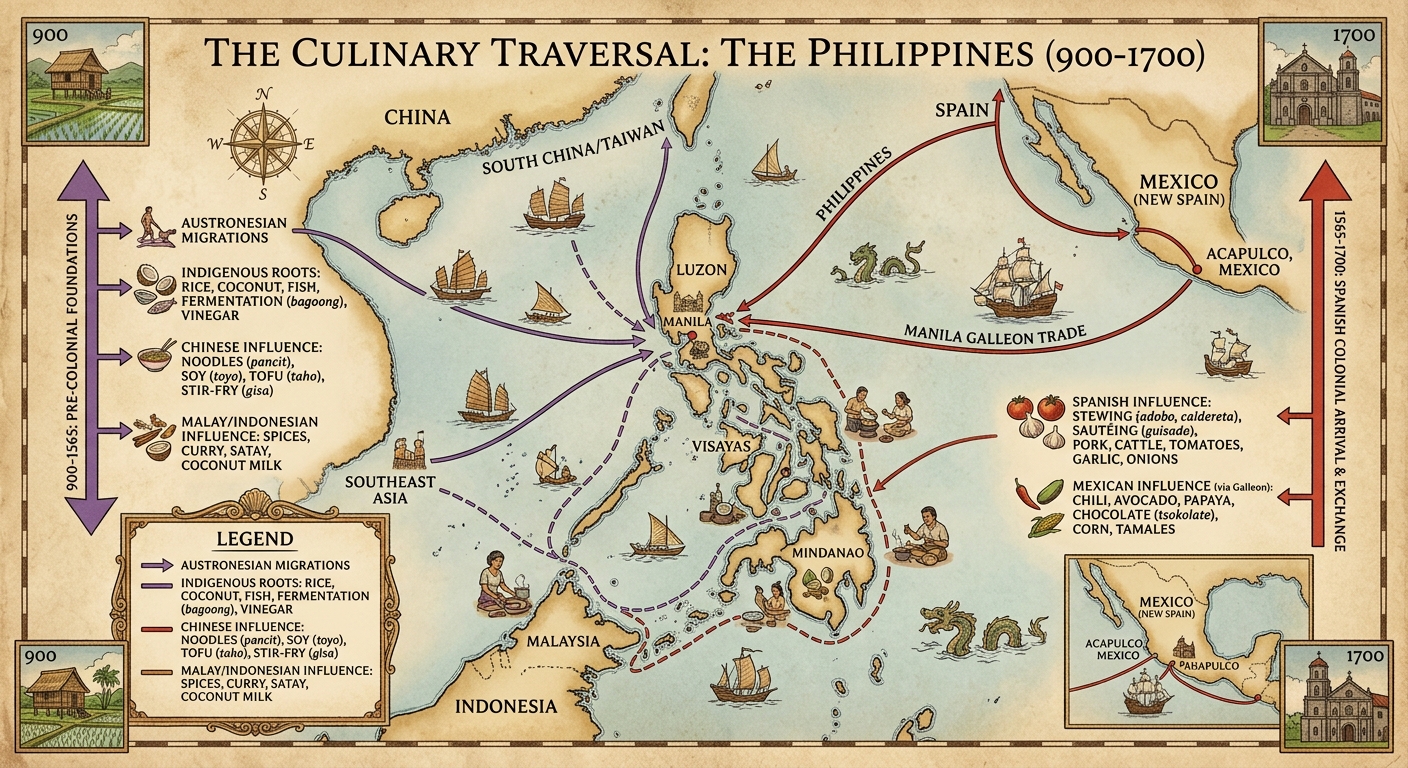
Fig 1. The Culinary Nodes: Map of the polities involved in trade and culinary exchange (900–1700).
I. 900–1100 — Foundations and the Nanhai storage revolution
By the time the Nanhai (South Sea) trade intensifies in the late 10th century, the polities of the lowland-river-delta band — Tondo, the proto-Manila Bay settlements, Cebu, Butuan, the Cotabato basin, the Sulu archipelago — already operate four technique lineages that will outlast every empire that ever tries to rename them:
- Vinegar-and-salt preservation — the ancestor of the adobo lineage. Suka (palm or coconut vinegar) plus asin (sea salt). No soy. No chili. The chemistry is lactobacillus and acetic-acid stabilization of meat and fish.
- Souring with native acids — the ancestor of the sinigang lineage. Sampalok (tamarind), batuan, kamias, libas, native citrus. No tomato. The function is to brighten and preserve hot broths in a tropical climate.
- Acid-denatured raw preparation — the kinilaw lineage. Vinegar and ginger denaturing fish protein. No chili. The early-contact chroniclers will describe this in the 1521 Visayas, but by then it is already centuries old.
- Direct-fire whole-animal roasting — the ancestor of the inihaw and lechon lineages. Bamboo skewer or split-pole over coals.
What changes in this window is not the techniques. What changes is storage. Chinese stoneware jars — tapayan, gusi — arrive in scale via the Nanhai trade. Long-form fermentation moves from household batch to surplus economy. Bagoong and patis are no longer just for the family salt-cellar; they become tradeable goods. The primary record (Morga, 1609) attests the centrality of palm and nipa wine to these polities in generic terms; it is a plausible inference, not a documented fact, that the rice wines named in later sources (tapuy, pangasi, intus, basi) already circulated in this window as aged, named, gift-exchanged vintages stored in ceramic vessels that doubled as treaty objects.
Linguistic substrate. The food vocabulary of this period is overwhelmingly Austronesian. Beras (husked rice) → bigas. Proto-Malayo-Polynesian qasiRa → asin. Suka (vinegar/sour) is shared across the Malay world. There are almost no loanwords in the household register. The kitchens speak in their oldest voice.
II. 1100–1300 — The spice pulse
The Indianized maritime networks reach into the elite households of Manila Bay, Cebu, Butuan, and Sulu. Black pepper from the Indian Ocean. Turmeric (kunyit / luyang dilaw). Amplified ginger use. Sanskrit-via-Malay food vocabulary layers onto the Austronesian core: gula (palm sugar) drifts in meaning toward gulay; the lexicons of milk, of clarified fats, of measured spice begin to stabilize.
This is, importantly, an elite-stratum transformation. The household kitchens of fishing villages and rice-terrace hamlets are not eating black pepper in 1200. The datu’s table is. The court of the Sultan-to-be is. The babaylan preparing a feast for a foreign captain is. The vernacular cuisine remains rooted in the four lineages.
The most consequential introduction in this window is not a flavor — it is betel-areca chewing (nganga: betel leaf, areca nut, slaked lime). It is not nourishment; it is political consumption. Every diplomatic reception, every treaty negotiation, every alliance feast goes through the betel set. The nganga is the handshake of the maritime Southeast Asian arc. By 1300 it is universal in the elite reception protocol of the polities of the archipelago.
Rice itself intensifies. The Cordillera terraces consolidate. Wet-field cultivation expands in the irrigated lowlands. Rice surpluses underwrite the rice-wine economy, which in turn underwrites the diplomatic economy. You cannot run a treaty without a cup — though whether the cup held an aged, named vintage or simply the generic palm and rice wine the primary record attests is more than the corpus can settle.
III. 1300–1450 — Ming intensification, the fermented-and-preserved trade
The Yuan and then the Ming reorganize the Chinese trade. The Ming Haijin sea ban, paradoxically, deepens the role of Sulu, Brunei, and Maynila as transshipment hubs. The Pangasinan coastal flats, Capiz, Iloilo — these become fermentation centers with bagoong and patis moving outbound on Chinese-Borneo-Malay shipping. Salted preserves and fish sauces are now export commodities, not just household staples.
Stoneware moves inbound at a scale that reshapes domestic culinary infrastructure. Elite gift-exchange protocols formalize around wine and jar. It is plausible — though beyond what the primary record fixes — that rice wines hardened into named regional vintages and that a treaty was sealed with a named wine in a named jar from a named maker in a named kiln. The food economy and the diplomatic economy are the same economy.
Linguistic seeds. Hokkien Chinese loanwords begin to layer onto trade-elite households. By standard linguistic scholarship — these specific etymologies are externally sourced, not drawn from the primary corpus — toyo derives from Hokkien tāu-iû (soy sauce), tahuri / tahure from a fermented-bean-curd term, bihon from a rice-noodle term. Most of these will not stabilize as fully vernacular until after 1565 — but the trade contact that plants the lexical seeds belongs to this 14th–15th-century window. The polities are already tasting the words they will later think of as their own.
IV. 1450–1521 — The Halal Turn
This is one of the most traceable and most narratively under-reported culinary events of the pre-contact period — datable by standard historiography, with the underlying mechanism anchored in the corpus even where the exact years are not. It deserves a clean naming.
By standard historiography the Sulu sultanate is consolidated around 1457 and the Maguindanao sultanate in the early 16th century; these precise years rest on conventional dating rather than on the primary culinary corpus. What the corpus does anchor is the mechanism — the Islamization of these courts and its effect on court cuisine. Bruneian Islamic influence reaches Maynila in the same window. In each of these elite courts, pork is displaced from court cuisine. Goat, beef, poultry, and fish absorb the protein load.
This is not a generic “Islamic influence.” It is a traceable, court-level culinary shift with a named direction — datable to within a few decades by standard historiography even where the exact founding years are not fixed by the primary record. Vernacular and upland cuisines are not uniformly affected. The Manila Bay table at 1500 is split — Maynila partial halal, Tondo retaining older mixed practice. The geography matters; the polity matters; the household stratum matters.
What enters with the halal turn is just as concrete:
- Coconut-cream-based clarified-butter analogues, mapping the South Asian ghee function onto the local fat economy.
- Spice mixes following Malay–Indian Ocean templates.
- Rice-and-meat preparations in the Malay biryani-adjacent family — anchored at the elite-court level, not the household.
Linguistic loadout. Arabic-via-Malay vocabulary stabilizes in the Sulu and Maguindanao courts: halal, haram, kanduli (ritual feast), sapi (cattle/beef, via Malay), manuk (Austronesian, but ritually re-anchored). By standard linguistic scholarship — externally sourced rather than drawn from the primary corpus — the loanword direction runs Arabic → Malay → court Tausug / court Maguindanaon. This is the layer that the colonial archive often erases or recasts as “Moro influence” without naming the actual mechanism.
V. 1521–1565 — Encounter cuisine, the table Pigafetta saw
When Magellan’s expedition reaches the Visayas in 1521, the chroniclers of the encounter sit at a table that is the cumulative product of the previous four movements. The early-contact record describes rice as the central staple, palm wine as a central drink (the primary corpus attests its centrality in generic terms, not a roster of named varieties), roast pig in the inihaw lineage, raw fish denatured in vinegar and ginger (kinilaw, without chili, without tomato), banana, citrus, and a feast structure organized around the sandugo — the blood compact.
The sandugo is the central anchor. It is a kinship-by-ritual-food-sharing instrument. It is treaty diplomacy with an edible signature. Magellan and his successors will read it as submission. That is the categorical mistake of Story 9. It is also a culinary mistake: they did not understand what they were eating.
Rice wine and palm wine are central to diplomatic reception. Refusal of the cup is a diplomatic event in itself. Sobriety and inebriation are choreographed. The early Iberian observers, raised on a different alcohol-and-honor culture, repeatedly misread this choreography.
Linguistic anchor. The earliest written transcriptions of Visayan food vocabulary appear in this window via the early-contact chroniclers. Spellings are unstable; root forms — kanin, inihaw, suka — are recognizable and consistent with the modern Visayan registers. The lexicon survives the transcription.
VI. 1565–1600 — The Galleon arrives, the Columbian Exchange enters the lineages
From 1565 onward, the Manila–Acapulco Galleon delivers the Mesoamerican cultivars that will, within two generations, restructure how nearly every kitchen in the lowland archipelago tastes:
- Chili (sili, siling labuyo).
- Tomato (kamatis).
- Corn (mais).
- Sweet potato (kamote).
- Squash (Mesoamerican varieties of kalabasa).
- Peanut (mani).
- Pineapple (pinya).
- Cacao (kakaw).
- Achiote (atsuete).
- Papaya, guava, avocado.
The crucial point — and this is the load-bearing claim of the entire traversal — is that the adoption pattern is additive into existing lineages, not replacement.
Kinilaw acquires chili. The vinegar-and-ginger base remains. Sinigang acquires tomato as one souring option, alongside tamarind, kamias, batuan, libas. Adobo’s vinegar-and-salt base is unchanged; chili enters in regional variants. Among these cultivars the primary record (Morga, 1609) attests camote, pineapple, and guava as established; maize and cacao it mentions only comparatively, so their establishment as locally grown crops in this window is an inference from later evidence rather than something the corpus fixes. On that same comparative footing, cacao prepared as tsokolate plausibly becomes an elite morning-table drink in mestizo and Spanish households toward the turn of the century, diffusing to creole households across the 17th c.
Adoption is graded. Uplands, lowlands, coastal trade-elite households absorb the Columbian cultivars at different rates. The Cordillera terraces are still rice-and-pinikpikan in 1600. The Manila convent kitchens are already eating tsokolate with toasted bread.
Linguistic flood. Nahuatl-via-Spanish loanwords enter the food register at scale. By standard linguistic scholarship — these derivations are externally sourced rather than attested in the primary corpus — kamatis traces to tomatl, kamote to camotli, atsuete to achiotl, kakaw to cacahuatl, tsokolate to xocolatl, and abokado (late) to ahuacatl. The mediating Spanish is often Mexican galleon-crew Spanish, not peninsular Spanish — a pattern modern philology reads off the lexical evidence if you know to look for it.
VII. 1600–1650 — Reduction kitchens, convent cuisine, wheat and lard
The mission orders — Augustinian, Franciscan, Jesuit, Dominican — establish convent kitchens that become recipe-and-technique transmission hubs. Wheat-based liturgical bread, lard-pastry (the empanada lineage), egg-yolk sweets (yema, leche flan, the tocino del cielo family), and almond-and-rice puddings stabilize in mestizo and indio-elite households around mission towns.
Distilled spirits in the European sense (aguardiente) supplement, and partially restructure, the rice-wine and palm-wine economy. Lambanog — high-proof distilled palm wine — stabilizes and spreads in this window. Note that distillation here is not a European import grafted onto local fermentation: Morga (1609) already attests native distillation of tuba into a clear, brandy-strength spirit using the polities’ own furnaces. What this window does is broaden and entrench that existing distilling practice within the reducción-era economy.
The reducción policy concentrates dispersed populations around churches. The kitchen geography of the modern-day archipelago is partly a reducción artifact: many of the “town dishes” of the central Luzon and Visayan plains are reducción-era stabilizations of older village foodways, now centered on a bayan with a stone church and a friar.
Spanish loanwords stabilize en masse. Adobo — originally a Spanish marination term — is retroactively applied to the pre-existing vinegar-and-salt lineage. Escabeche, menudo, morcón, embutido, almondigas, paella-adjacent rice preparations, leche flan, ensaymada, arroz caldo (← arroz + Hokkien-Spanish hybrid). The direction is Spanish → vernacular, with a Hokkien interlayer in Manila that the friar archive often does not see.
The single most-misunderstood lexical fact of Philippine cuisine sits in this paragraph: the word adobo is Spanish; the technique is older than Spain.
VIII. 1650–1700 — Galleon-era creolization, the lexicon stabilizes
By 1700 the cuisine of the lowland Christianized population has stabilized into a form that contemporary palates would still recognize. Three communities do most of the stabilizing:
The Hokkien Chinese cooks of the Parián de los Sangleyes in Manila fix the noodle-and-stir-fry register. By standard linguistic scholarship — externally sourced, not in the primary corpus — pancit derives from Hokkien piān-ê-si̍t (“something quickly cooked”) and lumpia from Hokkien lūn-piáⁿ; bihon, misua, toyo, tahure, and ampaw belong to the same borrowing layer. By 1700 this lexicon is set; later regional variations elaborate on top of it.
Mexican migrant cooks — galleon crew, soldiers, mestizos, Acapulco-born artisans settling in Cavite and Manila — finish the chili-tomato-corn restructuring of the four lineages. Tamales-lineage and atole-lineage preparations enter regional repertoires; some persist in modified form (the suman and bibingka kin), others fade.
Convent and creole kitchens stabilize the Spanish-Catholic feast calendar onto the older feast structures. Lechon-as-feast is now associated with fiestas, but the technique is direct continuation of the inihaw lineage from the Tondo, Cebu, and Butuan polities of the 10th–14th centuries. The fiesta is new; the pig over the coals is not.
Adobo crystallizes in this window as a named, codified preparation — vinegar, salt, garlic, pepper, with soy sauce as an elective Hokkien-influenced addition by late 17th c. It is the meeting point of the pre-1565 vinegar-and-salt lineage, Spanish marination terminology, and Hokkien fermentation imports. One word; three histories layered into it.
The four-layer lexicon
By 1700 the food register of lowland Christianized populations has settled into a four-layer lexicon, present in nearly every meal, usually invisible to the speaker:
- Austronesian core — rice, salt, vinegar, fish, coconut, ginger, the four technique lineages.
- Sanskrit–Malay layer — turmeric, betel-areca, the elite-stratum spice register.
- Arabic–Malay layer — present in Mindanao Muslim cuisines as the load-bearing layer; present in lowland Christianized cuisines as residual borrowing through coastal trade.
- Hokkien layer — noodles, soy, fermented bean, the Parián stir-fry register.
- Spanish–Nahuatl layer — Columbian Exchange ingredients, Spanish-named preparations, the convent sweets and bread register.
(That is five layers. We rounded down in the earlier dossier; the historical record rounds up.)
A speaker in 1700 Manila ordering adobong manok sa toyo with sinigang na kamatis on the side, finished with tsokolate and ensaymada, is — without knowing it — speaking five language families at one table. The kitchen is the most polyglot room in the archipelago.
What this traversal claims, and what it does not
Anchored.
- The four pre-Hispanic technique lineages, operative by 900 CE, surviving into the present as the load-bearing structure of contemporary cooking.
- The Nanhai stoneware-storage transformation as the engine of surplus fermentation.
- The halal turns of the Sulu and Maguindanao courts as elite-court culinary events (the Islamization mechanism is corpus-anchored; the precise founding years rest on standard historiography, not the primary record).
- The early-contact-attested kinilaw, central palm wine, and sandugo feast in the 1521 Visayas — without chili, without tomato.
- The Manila Galleon (1565+) as the delivery mechanism for Columbian Exchange cultivars, with graded household uptake and additive integration into existing lineages.
- The Parián-Hokkien stabilization of the noodle and soy register by 1700.
- The four-to-five-layer lexicon as the documented end-state — the substrate layering is anchored; the specific loanword etymologies rest on standard linguistic scholarship, externally sourced.
Plausible but not load-bearing.
- Exact dates for the household-level (vs. court-level) uptake of Indian Ocean spices in the 12th–13th c.
- The full diffusion timeline of tsokolate from elite Manila to provincial creole households across the 17th c.
- Rice wines (tapuy, pangasi, intus, basi) circulating as aged, named, gift-exchanged vintages this early — the primary record attests only the generic centrality of palm and rice wine.
- Maize and cacao as locally grown crops by the late 16th c. — Morga mentions them only comparatively; camote, pineapple, and guava are the cultivars the corpus actually attests as established.
- The precise founding years of the Sulu (1457) and Maguindanao (early 16th c.) sultanates — standard historiography, not corpus-fixed.
Quarantined.
- “Filipino cuisine” as a category for any moment before the late 19th-century nationalist consolidation.
- “Adobo is a Spanish dish” — false; the technique predates Spain by centuries; only the name is Spanish.
- “Pre-colonial cuisine was static” — false; the centuries-long restructuring through Nanhai, Indian Ocean, Halal Turn, and Galleon networks is the most documented dynamism in the regional record.
- “The Columbian Exchange replaced indigenous foodways” — false; it was absorbed, layered, and additively integrated. The lineages survived.
Publication-lock disclosure
This entry is the synthesis of Cycles 48–55 of the Agent Framework. It was led by Agent-Culinary, with Agent-Historian and Agent-Linguistic as primary supports, and Agent-Maritime, Agent-Curator, and Agent-Legal in cross-check. All claims are anchored unless flagged above. Side Quest 01 anachronism rules are active.
The cycles, with their per-agent journals, ledgers, and knowledge-graph runs, are published in the API Research Log.
The kitchen has the longest memory in the archipelago. This is what eight hundred years of it look like, written down.
